Sunday, 5 May 2013

ISS Expedition 10

The Expedition 10 patch uses simple symbolism to describe the mission. The large Roman numeral "X," formed by the American and Russian flags, symbolizes the joint nature of this mission, as well as the fact that this flight is the 10th mission to stay on the International Space Station (ISS). The current configuration of the ISS is next to the name of the ISS Commander, while the Soyuz vehicle is placed next to the name of the Soyuz Commander. The single star and the black background signify this is a space mission.
 
Expedition 10 to the International Space Station Insignia Patch Design
 

The crewmembers for Expedition 10 take a break from training in the United States, Russia and other venues to pose for their crew portrait. Astronaut Leroy Chiao, left, is commander and NASA ISS science officer. Cosmonaut Salizhan S. Sharipov, representing Russia’s Federal Space Agency, is flight engineer.

Leroy Chiao and Salizhan Sharipov Crew of ISS Expedition 10

Expedition 9 - ISS Mission

Astronaut Edward M. (Mike) Fincke (left), Expedition 9 NASA ISS science officer and flight engineer, and cosmonaut Gennady I. Padalka, commander, pose for their crew portrait while in training at the Gagarin Cosmonaut Training Center in Star City, Russia. Padalka represents the Russian Federal Space Agency.
 
Official NASA Portrait of Mike Fincke and Gennady Padalka Expedition 9


The emblem represents the Ninth Expedition to the International Space Station. The Soyuz rocket and letter "X" combine into the Roman numeral IX. The "X" evokes Exploration, which is at the core of the indivisible partnership of the two space pioneering nations. Research aboard ISS will lead to human exploration of the Moon and Mars. This pursuit is strengthened by the common memory of the astronauts and cosmonauts who gave their lives in this valiant endeavour. Their stars form the leading edge of the wings of the eagle spirit that embodies Human Space Flight. The Astronaut symbol is flanked by the Expedition 9 crew names leaning together, with a "9" stylized as the plume of their rocket. The baton of great discovery is passed to the crew of the spaceship advancing to their orbital outpost.
ISS Expedition 9 Mission Patch Insignia
 

International Space Station Missions - Expanding the Final Frontier

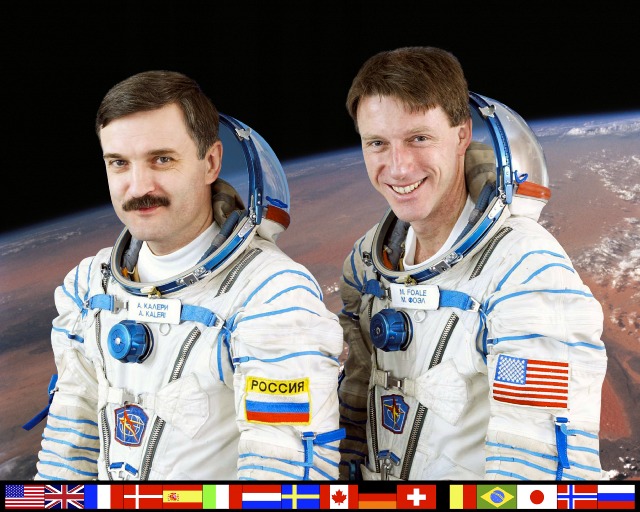
Astronaut C. Michael Foale (right), Expedition 8 mission commander, and cosmonaut Alexander Y. Kaleri, flight engineer, pose for their crew portrait while in training at the Gagarin Cosmonaut Training Center in Star City, Russia for their scheduled launch in a Soyuz TMA-3 spacecraft later this year. Kaleri represents Rosaviakosmos.
 
A particular favourite of mine as the crew featured Briton Michael Foale.
 
Expedition 8 Crew Featuring Mike Foale and Alexander Kaleri in Sokol Suits
 

The Expedition 8 Insignia
 
This emblem represents the eighth long-duration expedition to the International Space Station. The banner encircling the Earth, as a stylized figure 8, combines the flags of the partner nations represented by the crew. The International Space Station is portrayed above the Earth in its assembly complete configuration. The names of the two crewmembers, Michael Foale and Alexander Kaleri, are depicted in the border.
 
ISS Expedition 8 Crew Patch Insignia Mike Foale and Alexander Kaleri


Missions to the International Space Station - Expedition 7

International Space Station Expedition 7 crew Malenchenko and Ed Lu

Expedition Seven Commander Yuri I. Malenchenko (left), and NASA ISS Science Officer and Flight Engineer Edward T. Lu pose for their crew portrait while in training at the Gagarin Cosmonaut Training Center in Star City. Russia prior to their flight. Malenchenko represents Rosaviakosmos, the Russian Aviation and Space Agency.
 
The Expedition 7 Insignia
 
The International Space Station (ISS) Expedition Seven patch consists of two elliptical orbits which evoke the histories of the two space programs from which the crew is drawn. The Russian and American flags are intersecting, representing the peaceful cooperation of the many countries contributing to the ISS. Two stars indicate the Station's goals of contributing to life on Earth through science and commerce.
 
The ISS 7 Mission Insignia from Spaceboosters


Expedition 6 to the International Space Station

Astronauts Donald R. Pettit (left), Expedition Six flight engineer; Kenneth D. Bowersox, mission commander; and cosmonaut Nikolai M. Budarin, flight engineer, attired in training versions of the shuttle launch and entry suit, pause from their training schedule for a crew portrait. The three will be launched to the International Space Station (ISS) in late autumn of this year aboard the Space Shuttle Endeavour. Budarin represents Rosaviakosmos.
 
ISS Expedition Crew Photo features Budarin Bowersox and Don Pettit
 

The International Space Station (ISS) Expedition 6 crew patch depicts the station orbiting the Earth on its mission of international cooperation and scientific research. The Earth is placed in the center of the patch to emphasize that work conducted aboard this orbiting laboratory is intended to improve life on our home planet. The shape of the Space Station’s orbit symbolizes the role that experience gained from ISS will have on future exploration of our solar system and beyond. The American and Russian flags encircling the Earth represent the native countries of the Expedition 6 crew members, which are just two of the many participant countries contributing to the ISS and committed to the peaceful exploration of space.
 
Crew Insignia Expedition 6 Budarin Bowersox and Don Pettit
 

ISS Expedition 5 Insignia

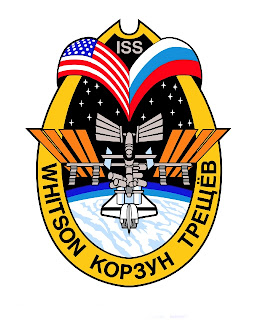
The International Space Station (ISS) Expedition Five patch depicts the Station in its completed configuration and represents the vision of mankind's first step as a permanent human presence in space. The United States and Russian flags are joined together in a Roman numeral V to represent both the nationalities of the crew and the fifth crew to live aboard the ISS. Crew members’ names are shown in the border of this patch. This increment encompasses a new phase in growth for the Station, with three Shuttle crews delivering critical components and building blocks to the ISS. To signify the participation of each crew member, the Shuttle is docked to the Station beneath a constellation of 17 stars symbolizing all those visiting and living aboard Station during this increment.
 
ISS Expedition 5 Crew Insignia Mission to the International space Station

 
Cosmonaut Valery G. Korzun (left), Expedition Five mission commander, astronaut Peggy A. Whitson and cosmonaut Sergei Y. Treschev, both flight engineers, are photographed prior to a mission training session in the Neutral Buoyancy Laboratory (NBL) near the Johnson Space Center (JSC). Korzun and Treschev represent Rosaviakosmos.

Expedition Patches Continued - ISS Expedition 4

The International Space Station (ISS) Expedition Four crew patch has an overall diamond shape, showing the "diamond in the rough" configuration of the Station during expedition four. The red hexagonal shape with stylized American and Russian flags represents the cross-sectional view of the S0 truss segment, which the crew will attach to the U.S. Lab Destiny. The persistent Sun shining on the Earth and Station represents the constant challenges that the crew and ground support team will face every day while operating the International Space Station, while shedding new light through daily research. The green portion of the Earth represents the fourth color in the visible spectrum and the black void of space represents humankind's constant quest to explore the unknown.